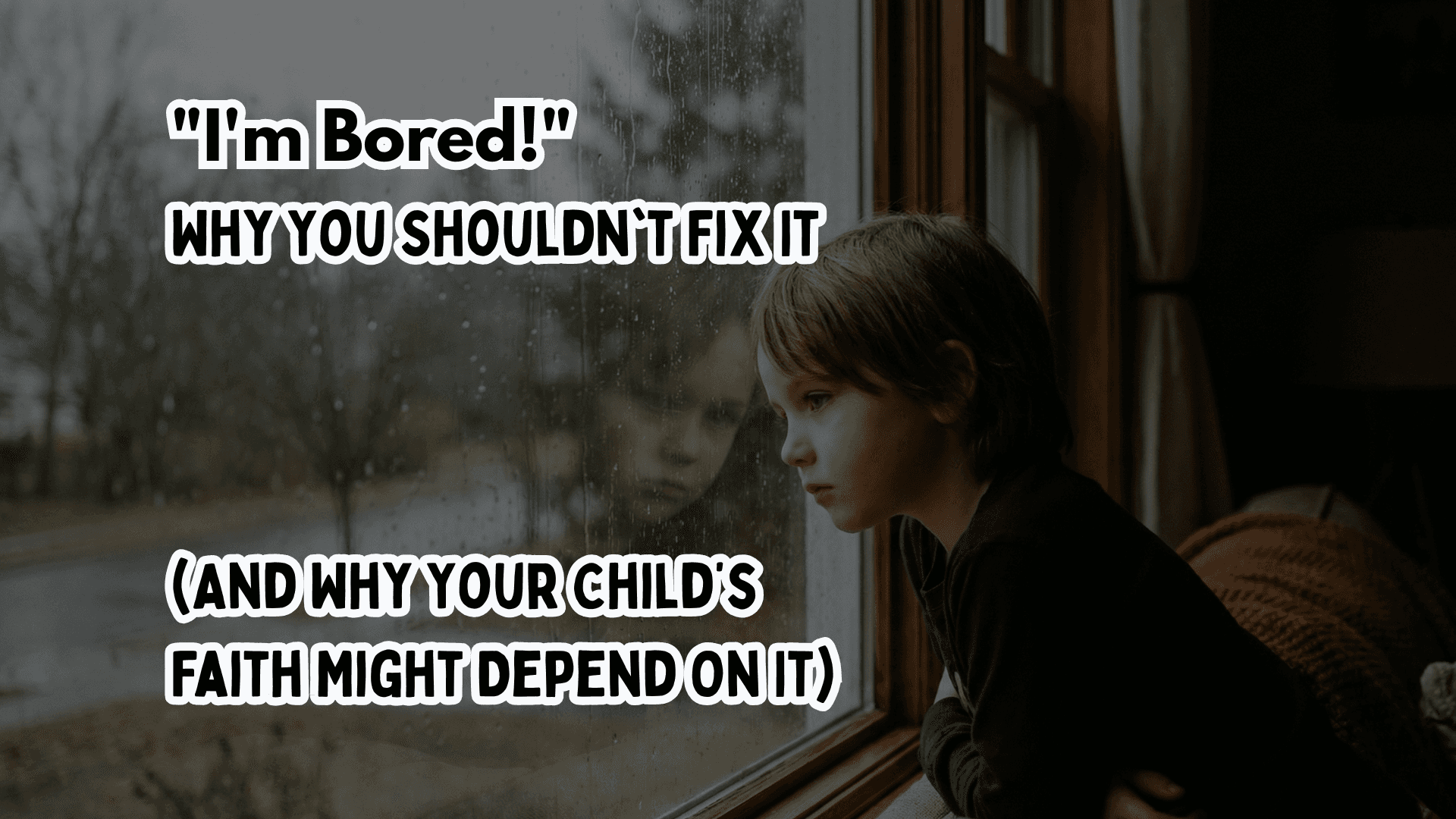
The Crisis of the Quiet Moment
It is the phrase that launches a thousand sighs.
It usually happens on a rainy Saturday afternoon. Or ten minutes into a long car ride. Or, most commonly, the exact second you take the iPad away.
“Mom… I’m booooored.”
It starts as a whine. It often escalates into a complaint. Sometimes, if the withdrawal from the screen is strong enough, it turns into a full-blown meltdown.
As parents, our modern instinct is to treat boredom like a medical emergency. We rush in with the defibrillators of entertainment.
“Why don’t you play a game?”
“Here, have a snack.”
“Okay, fine, just watch one show.”
We treat boredom as a problem to be solved. We treat it as a failure of parenting—as if a good parent is one who provides a ceaseless stream of enrichment and amusement.
But I want to challenge you with a radical thought, one that goes against the grain of our entire digital culture:
Boredom is a gift.
In fact, for the Christian parent raising a child in a loud, secular, hyper-connected world, boredom might be one of the most important spiritual disciplines you can teach.
Why?
Because God does not shout. He whispers.
And a child who has never learned to be bored—who has never learned to sit in silence without a device filling the void—is a child who will struggle to hear the whisper of God.
This isn’t just about “screen time” or “limiting phones.” This is about the formation of the human soul.
In this guide, we are going to look at why modern kids are so terrified of boredom, what the Bible says about the value of stillness, and how you—as a parent—can turn those “I’m bored” moments into the launchpad for creativity, faith, and deep reading.
Part 1: The Spiritual Danger of Constant Amusement
We rarely think about the word “amusement.”
We use it to mean fun, entertainment, or leisure. But look at the roots of the word.
The prefix “a-“ means “not” or “without.”
The root “muse” means “to think, to ponder, to reflect.”
Literally defined, amusement means “not thinking.”
Now, is amusement bad? Of course not. We all need rest. We all enjoy a laugh. God created us with the capacity for joy and play.
But we were not created for constant amusement.
We were created for “musing.” We were created to ponder. To reflect. To look at the stars and wonder who made them. To look at our own hearts and wonder why we feel what we feel.
The Noise That Drowns Out the Soul
The enemy of our souls does not always need to make us “bad” to destroy us. He simply needs to keep us busy.
If he can keep a child’s mind constantly occupied—with a YouTube video, a video game, a notification, a text message—he can keep that child from ever asking the big questions.
- Who am I?
- Why am I here?
- Is there a God?
- What is right and wrong?
These questions only bubble up in the quiet. They rise to the surface when the noise stops.
If the noise never stops, the questions never come.
A child who is addicted to constant stimulation is a child whose soul is calloused to the spiritual world. They become “sensory rich” but “spiritually poor.”
Scripture tells us, “Be still, and know that I am God” (Psalm 46:10).
Notice the order.
First, be still.
Then, know.
If we raise a generation of children who do not know how to be still—who view stillness as “boredom” to be escaped at all costs—we are raising a generation that will struggle to know God.
Part 2: The Science of the “Popcorn Brain“
Before we can fix the problem, we have to understand what is happening biologically in our children’s brains.
Parents often ask me, “Why is my child so irritable when they get off screens?”
Or, “Why can’t my son focus on a book for more than three minutes?”
The answer is dopamine.
Every time a child sees a new video clip, gets a “like,” or levels up in a game, their brain releases a hit of dopamine. It is the pleasure chemical. It feels good.
Modern technology is engineered—deliberately by psychologists and developers—to trigger this chemical loop as fast as possible.
- TikTok videos are 15 seconds long.
- Cartoons cut to a new angle every 3 seconds.
- Games reward players constantly.
The Crash
When you take the device away and say, “Go play outside,” or “Go read a book,” the dopamine tap shuts off.
The child’s brain is literally going through withdrawal.
The real world feels “slow.”
A book feels “boring.”
The grass and the trees feel “dull.”
This is what researchers call “Popcorn Brain.” The mind is so used to the popping, exploding, rapid-fire stimulation of the digital world that it loses the ability to process the slow, deep, meaningful pace of the real world.
When your child screams “I’m bored!”, what they are really saying is:
“My brain is uncomfortable because it isn’t being entertained effortlessly.”
Here is the good news:
The brain is plastic. It is moldable.
You can retrain a “popcorn brain” to become a “deep-thinking brain.”
But the only way to do it is to push through the boredom, not avoid it.
Part 3: Boredom is the Birthplace of Creativity
Let’s reframe the conversation.
Instead of viewing boredom as a void, let’s view it as a fertilizer.
History’s greatest thinkers, artists, inventors, and theologians all had one thing in common: They had time to think.
- David wrote the Psalms while watching sheep alone in a field.
- Isaac Newton formulated the laws of gravity while sitting under a tree.
- C.S. Lewis and J.R.R. Tolkien dreamed up Narnia and Middle-earth during long, quiet walks.
None of these things would have happened if they had an iPhone in their pocket.
Creation vs. Consumption
There are two ways a child can interact with the world:
- Consumption: Taking things in. (Watching, scrolling, listening).
- Creation: Putting things out. (Drawing, building, writing, imagining).
Screens train children to be Consumers. The machine does the work. The machine imagines the dragon. The machine creates the music. The child just sits and receives.
Boredom forces children to be Creators.
When a child is bored, eventually, the discomfort becomes too much. The brain wakes up and says, “Fine! If you won’t entertain me, I will entertain myself!”
This is the “Magic Moment.”
It usually happens about 15 to 20 minutes after the whining stops.
- Suddenly, the couch cushions become a fortress.
- Suddenly, a stick in the yard becomes the sword of Goliath.
- Suddenly, they pick up a book and start reading, not because you told them to, but because they are hungry for a world.
When we rush in to fix their boredom, we rob them of this moment. We steal their opportunity to create. We keep them stuck in “Consumer Mode” forever.
As Christian parents, we want to raise Creators. We are made in the image of a Creator God. When our children imagine, build, and invent, they are reflecting the Imago Dei—the image of God.
Part 4: Why Reading is the Ultimate “Good Boredom”
So, if we take away the screens, what fills the gap?
We don’t want them just staring at a wall. We want them engaging with something that builds character.
Enter: The Story.
Reading is the perfect bridge between boredom and engagement.
Unlike a movie, reading is active.
- The author gives the words.
- The child must build the pictures.
When your child reads a book about a boy facing a giant, your child has to imagine the giant. They have to hear the roar in their mind. They have to feel the fear.
This is a mental workout. It strengthens the “focus muscle” that screens have weakened.
The Moral Imagination
But for the Christian parent, reading does something even more powerful.
It builds the Moral Imagination.
In a secular world where “truth” is relative and “right and wrong” are blurry, children need to see clear examples of Good and Evil.
They need to see:
- Courage in the face of fear.
- Sacrifice for the sake of friends.
- Redemption for those who make mistakes.
- Light conquering darkness.
When a child is bored and picks up a good book, they aren’t just passing time. They are “rehearsing” for real life. They are walking in the shoes of a hero so that, one day, when they face their own dragons, they will know what courage looks like.
This is why Jesus taught in parables. He didn’t just give lectures. He told stories.
He knew that stories bypass our defenses and go straight to the heart.
If you want to teach your child biblical values, yes, take them to church. Yes, read the Bible. But also, give them stories where those values are lived out in thrilling, dangerous, beautiful ways.
Part 5: The “Boredom Detox” — A Practical Guide for Parents
Okay, you’re convinced. You want to reclaim your child’s brain and soul. You want to move them from “Screen Zombies” to “Creative Warriors.”
But how do you actually do it without causing a mutiny in your house?
You cannot just rip the band-aid off without a plan. You need a strategy.
Here is a step-by-step guide to the Boredom Detox.
Step 1: The “Clean Sweep” Audit
Look at your week. Where are the “filler” screen moments?
- The car ride to school.
- The 20 minutes while you cook dinner.
- The waiting room at the dentist.
- Saturday mornings.
Identify the times where you use screens as a babysitter. Pick one of those times to reclaim this week. Just one.
Step 2: The “I’m Bored” Script
When you implement this, your kids will push back. They will whine. You need a script so you don’t get angry.
Them: “Mom, I’m bored! There’s nothing to do!”
You: (Smiling, calm) “I love being bored. It means your brain is about to come up with a great idea. I can’t wait to see what it is.”
Them: “But can I just watch—”
You: “Not right now. You are smart. You’ll figure it out.”
Then—and this is the hardest part—turn away. Do not offer suggestions. Do not start playing with them immediately. Let them sit in the discomfort.
Trust the process.
Step 3: Strewing (The Art of Leaving Bait)
“Strewing” is a term used by educators. It simply means leaving interesting things lying around in plain sight, without saying a word.
If you tell a 10-year-old, “Go read this book,” they will resist. It feels like homework.
Instead, just leave the book on the coffee table.
Open it to an interesting illustration.
Leave a box of art supplies open on the floor.
Leave a puzzle started on the table.
When the boredom hits, their eyes will wander. They will see the bait. They will pick it up on their own terms. Autonomy is the key to engagement.
Step 4: Model the Behavior
If you tell your kids to get off their phones, but you are scrolling Instagram while you talk to them, you have lost the battle.
Kids mimic what we do, not what we say.
Let them see you sitting with a book.
Let them see you staring out the window with a cup of coffee, just thinking.
Let them see you praying.
Show them that adulthood isn’t just staring at a glowing rectangle.
Part 6: Choosing the Right Stories
If you are going to take away the high-stimulation entertainment of video games and TikTok, you have to replace it with something high-quality.
You cannot replace a Marvel movie with a boring, dusty, moralistic textbook. The child will revolt.
You need stories that are:
- Gripping: They need to hook the reader immediately.
- Meaningful: They need to contain truth, not just fluff.
- Clean: They need to be free of the toxic agendas found in so much modern media.
This is the heartbeat behind my writing.
I realized that Christian parents were stuck between a rock and a hard place.
On one side: Secular books that were exciting but filled with questionable messages.
On the other side: “Christian” books that were safe, but often boring or cheesy.
I wanted to build a third way.
I write books for the kid who thinks they hate reading.
I write books for the kid who loves video games.
I write stories with monsters, mysteries, danger, and adrenaline—but stories that are built on a foundation of biblical truth.
Stories where the “magic” isn’t occultism, but a reflection of the miraculous power of God.
Stories where the heroes aren’t snarky rebels, but brave children learning to listen to the “Still Small Voice.”
When you leave these kinds of books on the coffee table, you aren’t just giving your child a way to kill time.
You are giving them a safe place to wrestle with the concepts of good, evil, faith, and doubt.
You are giving their imagination a blueprint for holiness.
Conclusion: The Gift of Space
The next time your child comes to you, dragging their feet, complaining that there is “nothing to do,” take a deep breath.
Don’t feel guilty.
Don’t panic.
Smile at them.
You are about to give them a wonderful gift.
You are giving them the gift of Space.
Space to think. Space to dream. Space to hear the quiet hum of the world God made.
It will be uncomfortable for them at first. They might kick and scream.
But hold the line.
Because on the other side of that boredom is the child you have been praying for:
Creative. Grounded. Thoughtful.
And awake.
Looking for a Story to Spark Their Imagination?
If you are ready to start the “Boredom Detox” but need the right book to leave on the coffee table, start here.
Adventure. Truth. No screens required.